Cotton has been at the heart of the textile industry for generations.
It is used across apparel, home textiles, hospitality products and many other applications.
Today, however, buyers are looking beyond fibre quality and price.
They also want to understand how their cotton is grown.
One question comes up frequently:
Is organic cotton really better than conventional cotton?
The answer is not as simple as choosing one over the other.
To understand the difference, we need to start at the farm.
What Is Conventional Cotton?
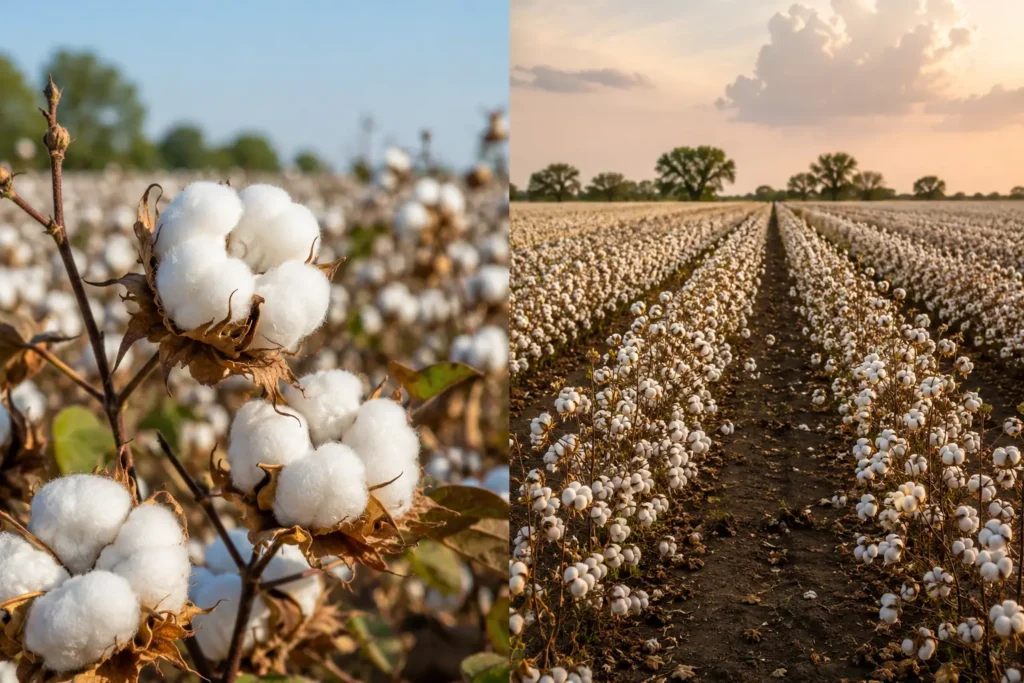
Conventional cotton is grown using established agricultural practices.
Depending on the region, farmers may use fertilizers, crop-protection products and irrigation.
The exact farming method can vary considerably from one location to another.
Modern conventional farming can also include practices such as crop rotation, soil testing and efficient irrigation.
Integrated Pest Management is increasingly used to control pests while reducing unnecessary chemical applications.
So, conventional cotton should not automatically be considered unsustainable.
Much depends on how it is actually grown.
What Is Organic Cotton?
Organic cotton is grown according to recognised organic farming standards.
These standards restrict the use of certain synthetic fertilizers and pesticides.
The focus is more strongly placed on soil health, biodiversity and natural farming processes.
Farmers may use crop rotation, composting and cover crops to maintain soil fertility.
Pest management can involve biological, mechanical and cultural methods.
When cotton is sold as certified organic, the claim must also be supported by the relevant certification and supply-chain controls.
This is an important distinction for textile buyers.
So, What Is the Main Difference?
The cotton fibre itself is not necessarily the main difference.
The biggest difference is how the cotton is cultivated.
Both conventional and organic cotton can produce good-quality fibre.
The difference lies mainly in farming practices, permitted inputs and the way the supply chain is managed.
This is why simply comparing the words “conventional” and “organic” does not tell the complete story.
Soil Management Matters
Healthy soil is important for any cotton farmer.
Organic farming places particular emphasis on maintaining soil fertility through natural processes.
Crop rotation, organic matter and cover crops can all contribute to healthier soil.
At the same time, responsible conventional farmers can use many of these practices too.
Reduced tillage, better nutrient management and crop rotation are not limited to organic farming.
In practical terms, the farming method matters more than the label alone.
Crop Protection
Crop protection is another area where the two systems differ.
Conventional cotton may use synthetic pesticides where they are permitted and considered necessary.
Organic standards place tighter restrictions on which crop-protection substances can be used.
Organic farmers therefore rely more heavily on alternative pest-management techniques.
But it is not accurate to reduce the discussion to “chemicals versus no chemicals.”
What matters is the type of input, how much is used, why it is used and how responsibly it is managed.
Good agricultural practices are important in both systems.
What About Water?
Water is often one of the first environmental issues buyers ask about.
But there is no single water figure that applies to all cotton.
Cotton grown in a rain-fed region will have a very different water profile from cotton grown using irrigation.
Climate, soil conditions, rainfall and irrigation technology all influence water use.
Even within the same farming system, water requirements can vary significantly.
Efficient irrigation and responsible water management can therefore make a major difference.
For buyers, actual production information is much more useful than relying only on general assumptions.
Carbon Footprint
Cotton’s environmental impact begins well before the fabric reaches a textile factory.
Agricultural activities such as fertilizer production, irrigation, farm machinery and field operations can contribute to greenhouse-gas emissions.
But the story does not stop at the farm.
Cotton is then spun into yarn, woven or knitted into fabric, dyed, finished and converted into a final product.
Transportation also adds to the overall footprint.
That is why the environmental impact of a textile should ideally be considered across its entire life cycle.
Does Organic Automatically Mean Better?
Organic cotton can offer meaningful environmental and supply-chain benefits.
However, an organic fibre does not automatically guarantee that the finished textile has a lower overall environmental impact.
For example, dyeing, finishing, energy consumption, transportation and product durability can all influence the final result.
This is where Life Cycle Assessment, or LCA, becomes useful.
Instead of looking at only one stage, LCA helps assess environmental impacts across the wider product life cycle.
For serious sustainability decisions, this broader view is important.
What About Fibre Quality?
Another common misconception is that organic cotton automatically means better-quality cotton.
That is not necessarily the case.
Fibre quality depends on several factors, including:
- Fibre length
- Fibre strength
- Micronaire
- Maturity
- Uniformity
The quality of spinning, weaving, dyeing and finishing also affects the final textile.
A well-managed conventional cotton can produce an excellent textile.
Certified organic cotton can also produce an excellent textile.
The key is selecting the right fibre for the intended product.
Why Certification Matters
For buyers making sustainability claims, certification is an important part of the process.
It provides a way to verify that the material meets a defined standard.
Buyers should understand which certification applies to the cotton being offered.
They should also check the certificate’s scope, validity and supply-chain coverage.
Traceability is equally important.
A sustainability claim is much stronger when it can be supported by proper documentation and a traceable supply chain.
What Should Textile Buyers Ask?
Instead of asking only:
“Is this cotton organic?”
buyers should ask a few more questions.
Where was the cotton grown?
How was it cultivated?
Was it rain-fed or irrigated?
How was water managed?
How was soil fertility maintained?
How were pests controlled?
Is the cotton certified?
Can the material be traced through the supply chain?
What environmental data is available?
And, importantly, will the fibre meet the performance requirements of the final product?
These questions provide a much clearer picture.
Looking Beyond the Fibre Label
Sustainable cotton is not about finding one perfect solution.
Organic cotton has an important place in the textile industry.
Responsible conventional cotton also has an important role to play.
Regenerative agriculture is bringing new ideas into cotton farming.
Recycled cotton provides another option for reducing dependence on virgin fibre.
At the same time, the industry is moving towards better measurement, traceability and transparency.
For textile buyers, this means looking beyond a simple label.
The real question is not only what the fibre is.
It is also how it was produced and what happens after it leaves the farm.
The Real Textile Perspective
At Real Textiles, we believe material selection should begin with understanding the complete picture.
The right cotton depends on the product, customer requirements, market expectations and sustainability objectives.
Certification and traceability can provide confidence.
Environmental data can help support better decisions.
And product performance should never be overlooked.
A textile that performs well, lasts longer and serves its intended purpose efficiently also has an important sustainability advantage.
Ultimately, conventional and organic cotton should not simply be viewed as “bad” and “good.”
They are different production systems with different considerations.
The better choice depends on the specific application and the information available.
Sustainability does not end with selecting the cotton.
It continues through spinning, weaving, dyeing, finishing, manufacturing and distribution.
And it continues through the useful life of the finished product.
The goal is not simply to choose a different fibre.
The goal is to choose the right fibre, for the right product, with the right information.