Polyester is one of the most widely used fibres in the world.
It is used in apparel, home textiles, hospitality products and many other applications.
But conventional polyester is mainly produced from fossil-based raw materials.
This has increased interest in recycled polyester.
Recycled polyester is often called rPET.
It uses recovered polyester-based material instead of producing all the fibre from new raw materials.
But there is more to recycled polyester than simply calling a product “recycled.”
For textile buyers, understanding the source, process, quality and certification is important.
What Is Recycled Polyester?
Recycled polyester is polyester fibre made from recovered materials.
The recovered material can come from different sources.
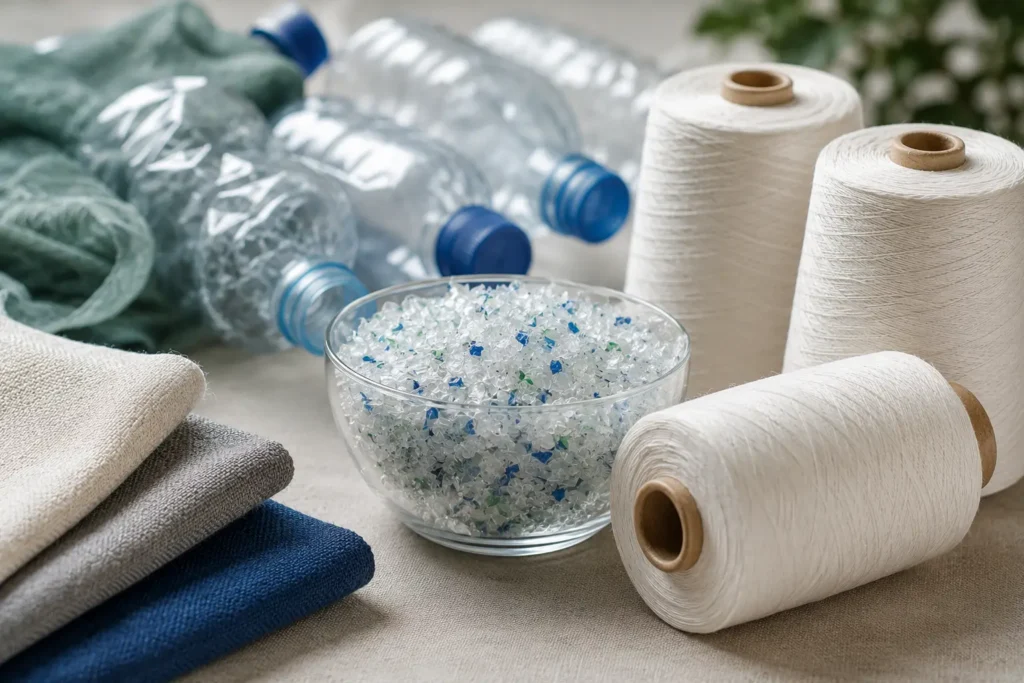
Today, most recycled polyester comes from PET plastic bottles.
It can also come from polyester textile waste.
Production waste can also be used as a feedstock.
The source of the recycled material is therefore an important question.
How Is Bottle-Based Polyester Recycled?
The process generally starts with collecting suitable PET bottles.
The bottles are sorted and cleaned.
They are then processed into flakes.
The flakes are converted into a suitable material for polyester production.
This material is melted and formed into polymer.
The polymer is then converted into chips or directly into fibre.
The fibre can finally be spun and used in textile production.
What Is Textile-to-Textile Recycling?
Textile-to-textile recycling is different.
Instead of starting with a plastic bottle, the raw material comes from textile products.
For example, discarded polyester garments or fabrics can become the feedstock.
This approach is particularly interesting for the textile industry.
It keeps textile materials within the textile system.
However, it is technically more challenging.
Used textiles can contain dyes, finishes, blends and other materials.
Sorting and separating them can be difficult.
Mechanical Recycling
Mechanical recycling is currently the most common route for recycled polyester.
The material is processed without fundamentally changing the polymer through chemical reactions.
It can be efficient when the feedstock is clean and consistent.
However, the quality of the incoming material is important.
Contamination can affect the final recycled material.
Chemical Recycling
Chemical recycling takes a different approach.
The polyester polymer is broken down into chemical building blocks.
These can then be used to create polyester again.
This can potentially provide higher-quality recycled feedstock.
It may also offer opportunities for difficult textile waste.
However, chemical recycling requires more specialised technology and infrastructure.
Cost, energy use and availability of suitable feedstock remain important considerations.
Why Are Brands Choosing Recycled Polyester?
One major reason is the opportunity to reduce reliance on virgin fossil-based polyester.
It also creates demand for recovered materials.
Recycling can help keep valuable resources in circulation.
For brands, recycled polyester can support specific material-sourcing goals.
For manufacturers, it provides another raw-material option.
But recycled content should always be considered together with product performance.
Is Recycled Polyester the Same as Virgin Polyester?
The basic polymer can be very similar.
Good-quality recycled polyester can provide excellent textile performance.
It can be used for yarns, fabrics and many finished products.
However, the quality of the recycled feedstock and processing route matters.
Proper control is essential to achieve consistent results.
What About Product Quality?
Buyers should not assume that recycled means lower quality.
Recycled polyester can be engineered for demanding applications.
Important factors include:
- Fibre strength
- Yarn construction
- Fabric construction
- Colour consistency
- Durability
- Shrinkage
- Pilling performance
Testing should be carried out according to the requirements of the product.
The finished textile should meet the same performance expectations as the intended application.
Does Recycled Polyester Reduce Environmental Impact?
It can provide environmental benefits compared with producing virgin polyester.
However, the actual benefit depends on the recycling technology, feedstock, energy source and system boundary used for the calculation.
There is no single environmental saving figure that applies to every recycled polyester product.
This is why buyers should be careful with simple percentage claims.
Reliable environmental information should explain the methodology behind the claim.
The Bottle Challenge
There is an important issue that buyers should understand.
Most recycled polyester currently comes from PET bottles.
This means the textile industry is competing for a material that is also needed by the packaging industry.
Textile Exchange reported that about 98% of recycled polyester feedstock in 2024 came from PET bottles. (Textile Exchange)
This is one reason why textile-to-textile recycling is becoming increasingly important.
Traceability Matters
A recycled-content claim should be supported by appropriate documentation.
Buyers should understand where the material originated.
They should also understand how it moved through the supply chain.
Certification can help provide this assurance.
The Global Recycled Standard (GRS) and Recycled Claim Standard (RCS) are recognised systems for recycled material and chain-of-custody claims. (Textile Exchange)
What Should Buyers Ask?
Before sourcing recycled polyester, buyers can ask:
Where does the recycled material come from?
Is it bottle-based or textile-based?
Is it pre-consumer or post-consumer?
What percentage of the product is recycled?
Is the recycled content certified?
Can the material be traced?
What testing has been carried out?
What quality specifications are available?
These questions can prevent confusion later.
Recycled Polyester and Microfibres
Polyester is a synthetic fibre.
Like other synthetic textiles, polyester products can release fibres during washing and use.
This is an important consideration when discussing the broader environmental impact of synthetic textiles.
Therefore, recycled polyester should not be presented as a complete solution to every sustainability issue.
It is one part of a wider strategy.
Design Also Matters
The sustainability of a textile product does not depend only on its fibre.
Product durability is important.
Efficient manufacturing is important.
Responsible dyeing and finishing are important.
Packaging and transportation also matter.
End-of-life options matter too.
A well-designed product can remain useful for a longer period.
What Is the Future?
The industry is moving towards more advanced recycling systems.
Textile-to-textile recycling is an important area of development.
Better sorting technologies can improve feedstock quality.
New recycling processes may allow more complex textile waste to be recovered.
The goal is to move beyond using waste from another industry.
The longer-term opportunity is to keep polyester textiles circulating within the textile system.
A Practical View for Buyers
Recycled polyester can be a valuable material choice.
But buyers should look beyond the word “recycled.”
Ask about the feedstock.
Ask about the recycling process.
Ask about certification.
Ask about traceability.
Ask about product performance.
And ask for supporting information behind environmental claims.
Conclusion
Recycled polyester provides an opportunity to reduce dependence on virgin fossil-based polyester.
It can also create value from materials that would otherwise become waste.
But today’s recycled polyester market still depends heavily on PET bottles.
Textile-to-textile recycling needs further development and investment.
For buyers, the best approach is to understand the complete material journey.
Where did it come from?
How was it recycled?
How was it verified?
And how will it perform in the finished product?
At Real Textiles, we believe sustainable material selection should never compromise the quality and performance expected from a finished textile.
The right material is the one that combines responsible sourcing, reliable quality, traceability and real product performance.
Because recycled does not simply mean using waste again.
It means giving valuable material another useful life.